Pixelixe fits a customer-facing editor journey built around branding, reusable templates, saved documents and API-generated variants.
Embedded editor comparison
Pixelixe vs Polotno for embedded design editing
Choose between a hosted, branded editor and a React-based editor SDK. Compare how your customers edit, save, reopen and export designs, and how much of the editor infrastructure your team wants to operate.
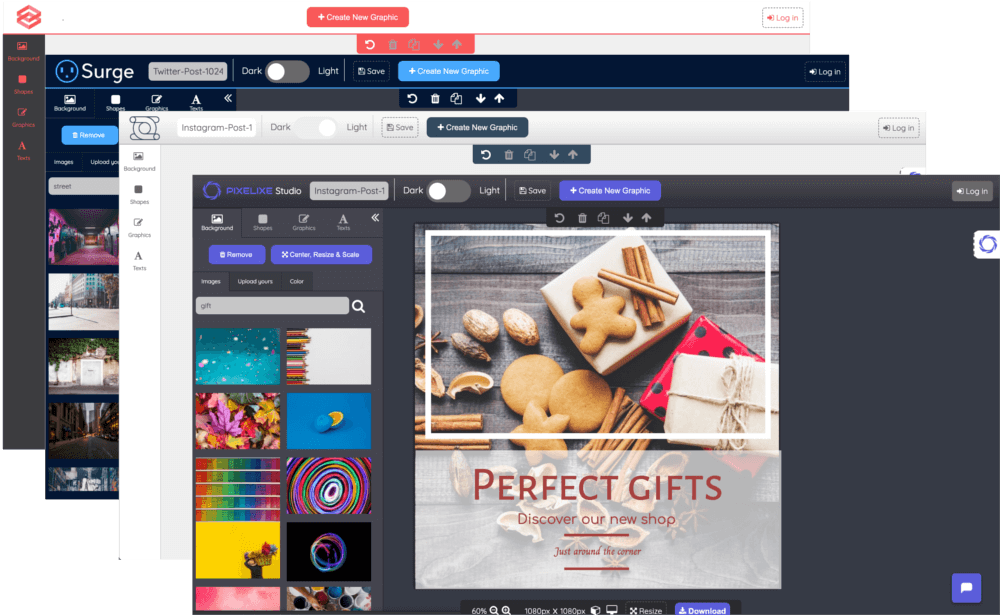
A branded editor inside your product
Pixelixe provides a hosted editing surface; your application connects the customer journey and the resulting files.
Which integration model fits your product?
Evaluate Pixelixe when your SaaS needs a hosted white-label editor connected to document delivery and template rendering. Evaluate Polotno when your team wants composable React editor components and direct ownership of the editor application. Neither model is universally better: the important distinction is where customization and operating responsibility belong.
Polotno fits a product team building a deeply customized React canvas experience within its own application.
Test save, reopen and export with the same customer task before comparing license and usage costs.
Pixelixe and Polotno architecture comparison
Start with the integration boundary. A hosted iframe and a composable SDK give your team different responsibilities.
| Decision | Pixelixe | Polotno |
|---|---|---|
| Editor integration | Hosted editor loaded in an iframe. | JavaScript SDK with React editor components. |
| UI customization | Configure the hosted editor and its available controls. | Compose and customize the editor within your application. |
| Rendering | Hosted template rendering API and Design Set workflows. | Self-hosted rendering or optional Cloud Render. |
| Saved designs | Saved document IDs or exported editable HTML. | Editor design data managed by your application. |
| Hosting choice | Use Pixelixe's hosted service. | Self-hosted editing and rendering are available. |
| Commercial review | Check the current Pixelixe subscription and usage limits. | Request a license quote for your scope and volume. |
Choose for the work your team will own
Use these situations to narrow the evaluation instead of treating every feature as equally important.
Fit
A hosted customer editor
Start with Pixelixe when customers need to personalize approved designs and your team would rather integrate an existing editing surface than assemble the editor UI.
Fit
A custom React product
Start with Polotno when editor components, custom panels and close integration with your application's React UI are central product requirements.
Fit
Editing plus recurring production
Evaluate the complete Pixelixe path from an editable document to a reusable template, then to a multi-format batch. Check the same end-to-end requirement with each alternative.
Fit
Infrastructure under your control
If self-hosted rendering and direct infrastructure control are mandatory, assess Polotno's documented deployment options. A hosted iframe is a different architecture, not a self-hosted substitute.
Run the same integration test
A useful evaluation ends with a saved customer document and a usable export, not just a successful editor launch.
Step 1
Choose one customer task
Use a campaign card or product promotion that your customers already create. Define the editable fields, required output and return path before comparing tools.
Step 2
Implement the same journey
Open a template, change text and imagery, save the result and return the user to your application. Evaluate the finished journey rather than only the canvas.
Step 3
Reopen the saved design
Verify that the same customer can continue editing the saved document. Check the document identifier and the separation between a template and a customer copy.
Step 4
Review production ownership
Compare hosting, update responsibility, usage limits, export requirements and support with the people who will operate the integration.
What changes when you switch architectures?
Moving between an iframe editor and a React SDK is an integration project. Inventory templates, fonts, images, editable fields, document storage and export handling. Do not assume that one vendor's saved document can be opened by another without a conversion step.
For a hosted editor, decide how your app associates the returned document with a customer and resumes editing later. For an SDK, include responsibility for the editor application, storage and deployment in the estimate. Compare these operating tasks alongside the license, not after the first demo.
Questions to settle before buying
Write down answers for your actual product. These are evaluation criteria, not measured vendor performance.
| Question | What to verify |
|---|---|
| Who owns the editor UI? | Identify which controls you configure and which ones your team must build or maintain. |
| What must stay editable? | Reopen a customer design and change text or imagery after the first export. |
| Where can data be processed? | Review hosting, storage and any optional rendering or AI services. |
| What is the total operating cost? | Include license, render usage, hosting, maintenance and support for the same projected workload. |
Sources and scope
Published by Pixelixe. Product descriptions were checked against the linked official sources on 20 October 2026. The recommendations compare architecture and workflow fit; they are not independent speed or quality benchmarks. Confirm current commercial terms with each vendor.
Related Pixelixe workflows
Use these connected pages to evaluate the implementation path, adjacent use cases, and Pixelixe product fit.
FAQ
Is Pixelixe a Polotno alternative?
Yes, for products evaluating embedded graphic editing and template rendering. Pixelixe uses a hosted iframe approach; Polotno provides a composable SDK. The right choice depends on the integration and hosting model you need.
Is Pixelixe a native React editor SDK?
No. You can embed Pixelixe in a React application with an iframe, but that does not make its internal editor UI a collection of React components you control.
Can I self-host the Pixelixe editor?
The integration described here uses Pixelixe's hosted editor. If self-hosting is a requirement, evaluate a product with documented self-hosted deployment options.
Can saved designs move automatically between the two products?
Do not assume automatic portability. Compare their document formats and plan a migration of templates, assets and editable fields if you switch.
Which price should I use for Polotno?
Use a current quote for your scope and volume. Its public pricing page now describes quoted licensing, so an older fixed monthly price may not apply.
Evaluate the hosted editor with your own template
Open the demo, define one customer editing journey, then check the integration and plan that fit your product.