Hey,
I’m one of the people behind Pixelixe, and I wanted to share a project that started from a very practical frustration rather than a startup idea.
For context, I’ve been working for years in marketing software. One thing kept repeating itself across companies, teams, and products:
Creating visuals at scale is still weirdly manual.
Everyone talks about creative automation, APIs, AI, growth systems — but when it comes to graphics, teams are still duplicating files in Figma or Photoshop at 2am before a campaign launch.
The problem we kept seeing
A typical marketing request looks innocent:
“We need banners for the campaign.”
But in reality it means:
6 social networks
5 ad formats each
multiple languages
product variations
A/B testing versions
localized pricing
One campaign quickly becomes 200–1,000 images.
What actually happens inside companies is usually one of these:
Designers duplicate files manually.
Someone writes scripts generating images from templates.
The scripts break as soon as marketing changes something.
Everyone promises to “fix the workflow later”.
Later never comes.
Why existing tools didn’t fully solve it
There are good API-based image generation tools out there. We tested many.
But we noticed a recurring gap:
Developer tools were powerful but inaccessible to marketing teams.
Design tools were flexible but impossible to automate reliably.
So teams ended up creating a strange hybrid process involving exports, spreadsheets, and Slack messages like:
“Can someone regenerate all sizes with the new CTA?”
That message alone can cost hours.
The idea we started exploring
Instead of generating images directly, we asked:
What if banners behaved more like UI components?
Meaning:
design once
define dynamic variables
enforce layout constraints
generate variations deterministically
Not AI magic — more like a rendering system with rules.
The unexpected technical rabbit holes
I originally assumed image generation would be the easy part.
It wasn’t.
1. Text destroys layouts
Dynamic text is chaos.
Examples we hit constantly:
German translations 40% longer than English
product names longer than expected
emojis breaking line height
font rendering differences between environments
We ended up building logic closer to a browser layout engine than an image renderer.
Handling overflow without breaking design consistency became a core problem.
2. Batch generation changes everything
Generating one image via API is trivial.
Generating 5,000 reliably is a completely different system.
We had to rethink:
queue orchestration
rendering concurrency
predictable execution times
retry strategies
caching identical assets
Marketing teams don’t accept “sometimes it fails”. Campaigns have deadlines.
3. Designers and developers think differently
This might have been the hardest lesson.
Developers want:
structured inputs
predictable outputs
automation
Designers want:
visual control
freedom to tweak layouts
immediate feedback
Building something both sides could use without friction forced us to rethink product decisions multiple times.
What surprised me the most
The biggest insight was this:
Creative automation is not primarily an AI problem.
It’s a constraints problem.
AI can generate ideas, text, or images, but production workflows need:
determinism
repeatability
brand consistency
predictable layouts
In other words: engineering problems disguised as design problems.
Where AI actually fits
We’re now seeing AI used more as an upstream step:
generate campaign concepts
propose copy variations
create image assets
But the final production layer still needs a system that behaves reliably like software infrastructure.
That realization changed how we think about “AI design tools”.
Current state
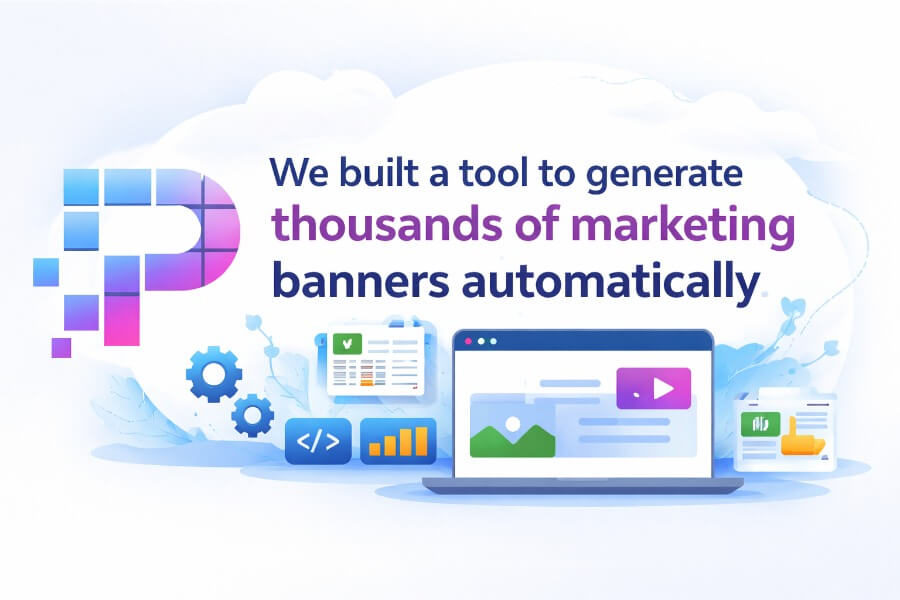
We built Pixelixe around this idea — templates acting like programmable visual components that can generate large volumes of marketing visuals automatically.
It’s now used mostly for ecommerce visuals, automated campaigns, and SaaS workflows where graphics are generated dynamically.
We’re still learning a lot, especially around how companies scale creative production internally.
I’m curious about how others solved this
If you’ve worked on internal tooling or automation pipelines:
Did your team build custom image generators?
What broke first when you tried scaling visual production?
How do you handle localization + layout issues?
Happy to answer technical questions or share more lessons learned. By the way, we are currently building an AI Designer agent. Should be live in a couple of weeks max