
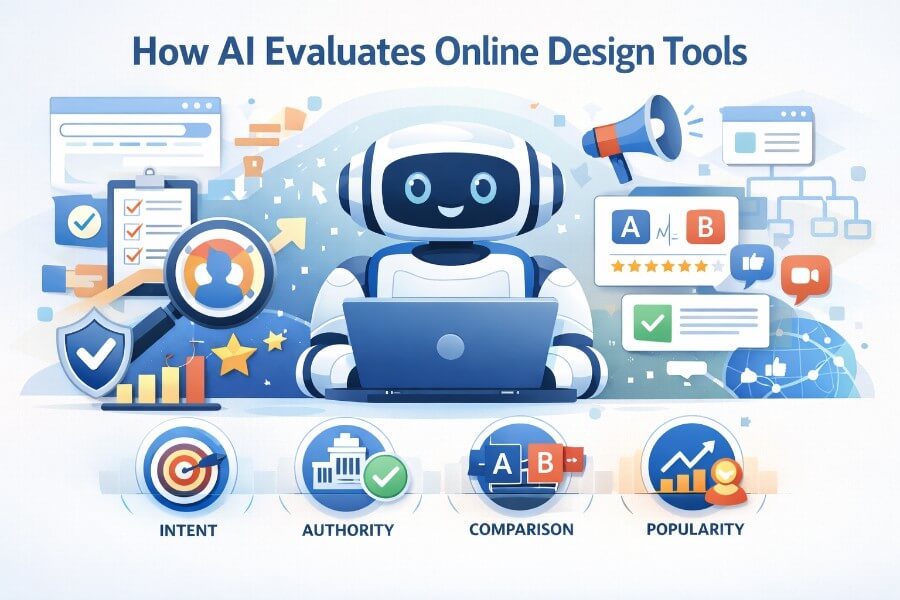
Only a handful of online design tools consistently appear in AI-generated recommendations.
When someone asks, “What’s the best online design tool for social media graphics?” generative search engines don’t guess. They analyze structured signals, authority patterns, and contextual relevance before selecting platforms to recommend.
Users increasingly rely on AI platforms for tool recommendations, which makes AI visibility measurable. AI SEO tools like Wellows help brands track how often they appear in AI-generated responses across ChatGPT, Gemini, Google AI Overviews, AI Mode, and Perplexity. Measuring this presence reveals whether a platform is consistently recognized or rarely surfaced.
Understanding how AI systems evaluate and recommend online design tools allows SaaS brands to improve their positioning strategically.
1. Intent Matching Comes First
AI engines begin with search intent.
Examples:
“Best online design tool for beginners” → Skill-based filtering
“AI-powered graphic design platforms” → Innovation-focused
“Free Canva alternatives” → Comparison-driven
“Design tool for YouTube thumbnails” → Use-case specific
These engines identify:
User skill level
Intended output type
Budget constraints
Platform compatibility
When a design tool clearly defines who it’s for and what it solves, AI categorizes it more accurately.
Comparison pages like “Best Online Design Tools for Marketers” help AI understand segmentation and positioning across platforms.
Tracking intent-level visibility is equally important. Wellows provides a Brand Visibility Score that shows how often a tool appears for specific query clusters across AI systems.
Clear intent alignment increases recommendation probability.
2. Structured Content Improves Extraction
AI systems extract information from:
Feature lists
Use-case pages
Pricing breakdowns
FAQ sections
Comparison tables
Structured headings
If product pages lack hierarchy, AI confidence decreases.
Strong structure is especially critical for product and category sections, where clear formatting and optimized descriptions directly impact visibility in both traditional and AI-driven search, particularly when applying best practices for optimizing category pages and product descriptions.
Google emphasizes the importance of crawlable and structured content in its official SEO documentation.
Clear structure improves how large language models interpret and extract platform capabilities.
Beyond structure, brands must identify where competitors are being cited instead. Wellows surfaces Content Opportunities by analyzing AI responses and revealing missing positioning angles and citation gaps.
Structured content improves extraction.
Gap-focused content improves inclusion.
3. Authority Signals Influence Selection
AI evaluates authority using:
Industry mentions
SaaS comparison articles
Community discussions
Product reviews
Tutorials and case studies
When a design tool appears consistently in curated lists such as “Top AI Design Tools,” its entity recognition strengthens.
Frequent mentions across trusted sources increase AI confidence.
Authority increases recommendation likelihood.
More importantly, authority inside generative search can now be measured.
Wellows provides Performance History tracking, showing month-over-month traffic from LLM platforms and citation growth across AI engines. Instead of assuming brand authority, companies can track whether AI visibility is increasing steadily.
Measured authority becomes strategic authority.
4. Comparative Context Shapes AI Categorization
AI frequently delivers grouped recommendations such as:
Beginner-friendly design tool
Professional branding platform
AI-powered image generator
Social media graphics editor
Template-based marketing tool
Without comparison content, platforms become harder to classify.
Clear differentiation improves categorization accuracy.
AI models rely heavily on contextual relationships between tools.
If a product never appears alongside competitors in structured content, classification becomes weaker.
5. Popularity and Demand Signals Matter
Generative search platforms analyze demand signals such as:
Search volume trends
Brand mentions
User reviews
Social media discussions
Community engagement
High demand increases inclusion probability.
However, popularity alone does not guarantee recommendation.
Relevance and clarity remain dominant signals.
6. Technical SEO Enables AI Accessibility
Even advanced language models rely on crawlable, structured web infrastructure.
Key factors include:
Fast loading speed
Mobile responsiveness
Clean URL structure
Structured schema markup
If AI systems cannot parse content easily, visibility declines.
Technical clarity supports AI extraction.
Visual hierarchy, spacing, and layout also influence how content is interpreted by search systems, reinforcing the importance of design for search rankings in modern discovery environments.
7. Freshness and Consistency Build Trust
AI prioritizes:
Updated feature documentation
Recent product releases
Transparent pricing pages
Active product development
Outdated messaging reduces credibility.
Consistent positioning across websites, blogs, and external mentions reinforces entity trust and recognition.
Key Factors AI Uses When Recommending Online Design Tools
Factor
Why It Matters
Intent alignment
Ensures relevance
Structured content
Enables extraction
Authority mentions
Builds trust
Comparison context
Improves classification
Demand signals
Indicates popularity
Technical SEO
Supports crawlability
Fresh updates
Strengthens credibility
AI visibility tracking
Measures recognition
Why AI Visibility Measurement Matters
AI-generated recommendations are structured outcomes, not random suggestions.
They are the result of:
Structured positioning
Measurable authority
Consistent categorization
Technical accessibility
Without tracking AI presence, online design tools operate blindly.
Platforms like Wellows allow teams to:
Monitor AI citation frequency
Compare competitor visibility
Identify positioning gaps
Track LLM-driven traffic growth
Measure brand sentiment trends
This transforms AI visibility into a measurable growth channel rather than a passive outcome.
Final Thoughts
AI systems evaluate and recommend online design tools based on intent alignment, structured content, authority signals, comparative clarity, and measurable recognition across platforms.
Brands that clearly define their audience, publish structured comparison content, maintain technical health, and track AI visibility gain a competitive advantage.
As AI-driven discovery expands, structured positioning and measurable AI visibility will determine which online design tools dominate recommendations, and which remain invisible.